When Hitting the Target Creates a Bigger Problem
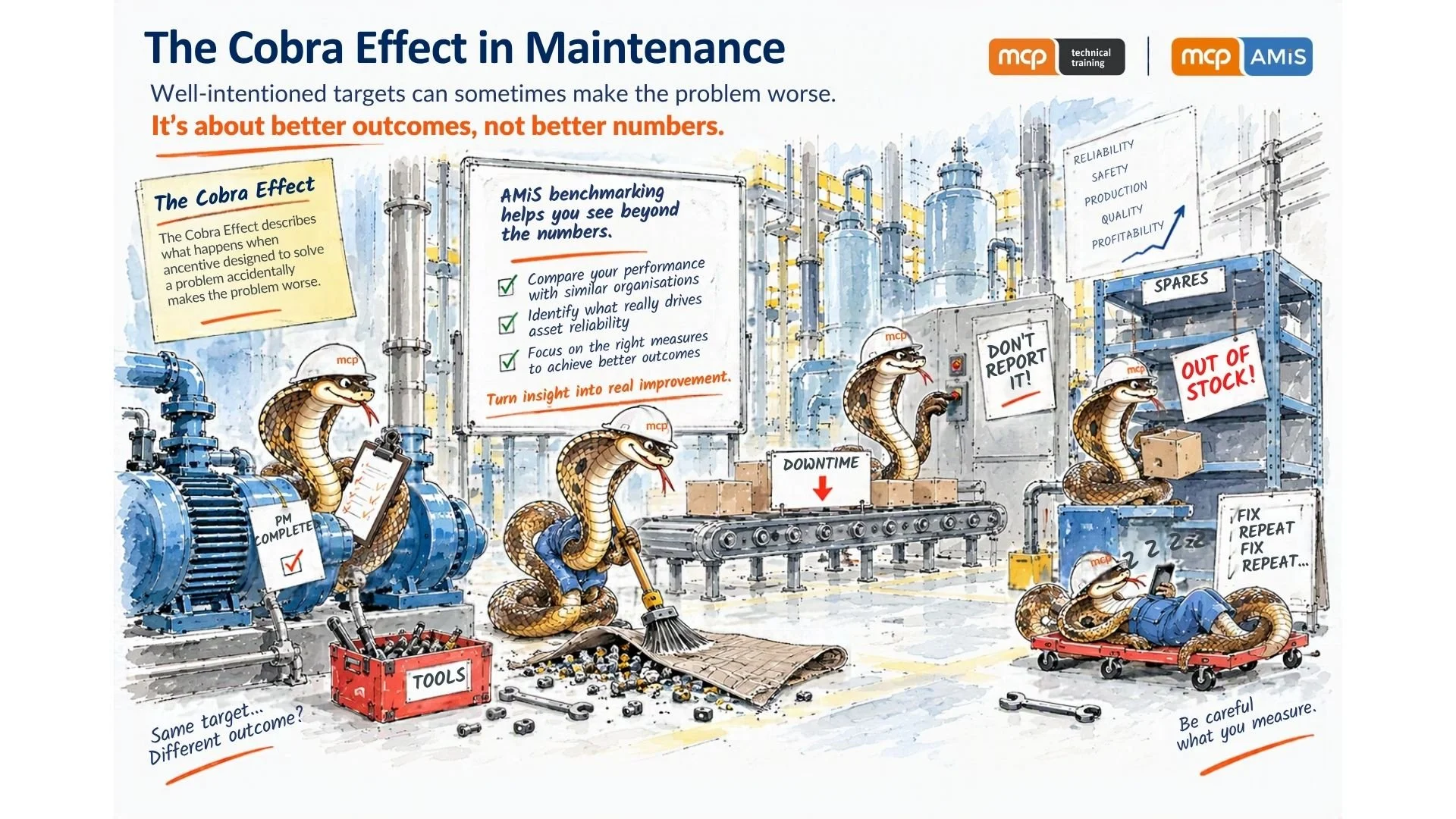
Sometimes hitting a KPI deserves a pat on the back.
Sometimes it deserves a closer look.
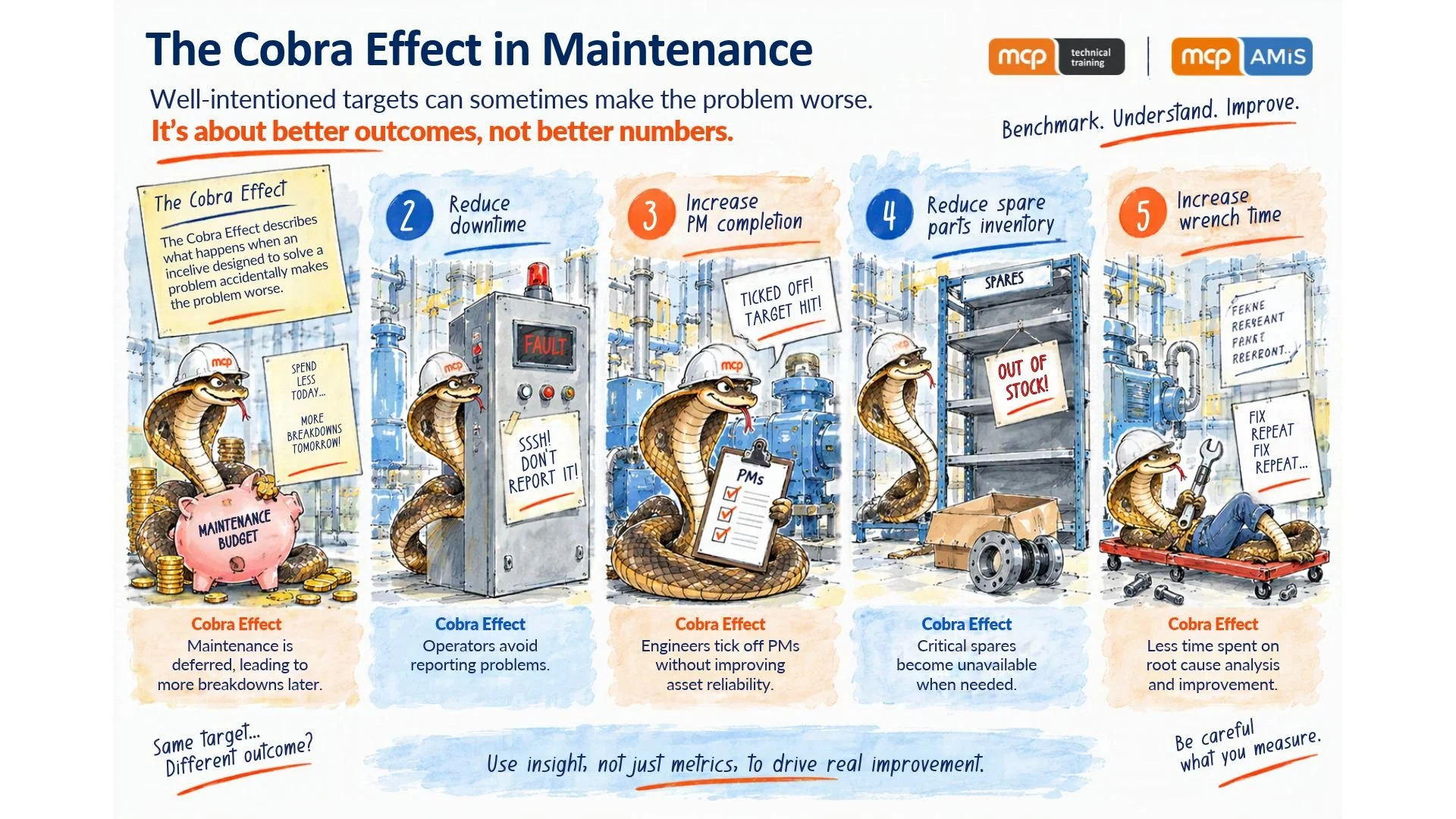
The Cobra Effect describes what happens when an incentive designed to solve a problem accidentally makes the problem worse. The name comes from a famous story about a bounty offered for dead cobras. Rather predictably, people worked out that breeding cobras was a rather efficient way of earning the reward.
Maintenance teams probably aren't breeding snakes. But the same principle can creep into maintenance performance surprisingly easily.
When a Good KPI Encourages the Wrong Behaviour
Take something perfectly reasonable, such as reducing maintenance spend.
If the target becomes the sole focus, maintenance could be deferred and costs fall. KPI achieved.
Until reliability suffers, failures increase and the business pays considerably more later.
The same problem can appear elsewhere:
Reduce downtime: problems go unreported to protect the number.
Increase planned maintenance completion: PMs get completed, but asset reliability doesn't improve.
Reduce spare parts inventory: stock levels look better until a critical spare isn't available.
Increase wrench time: engineers spend more time on tools but less time investigating why failures keep happening.
Everyone can technically hit their target while the assets quietly disagree.
What is AMIS?
The AMIS Journey is the roadmap to improving a company’s approach to maintenance and physical assets.
Related Articles

How Can Maintenance Development Centres Solve Key Industry Challenges?

It Opened My Eyes to a New Way of Thinking
Did Maintenance Do Maintenance?
That's where AMIS, the Asset Maintenance Improvement System, takes a broader view.
Rather than looking at individual maintenance measures in isolation, AMIS considers the maintenance system as a whole.
So instead of simply asking:
"Did we complete 95% of our PMs?"
a more useful question is:
"Has our PM strategy actually improved asset reliability?"
It's a small change in wording, but quite a significant change in thinking.
Maintenance activity isn't automatically maintenance improvement.
Look Forward as Well as Back
Measures such as downtime, cost, OEE and breakdown hours remain important. The difficulty is that they're largely telling you what has already happened.
By the time the figures move, the failure may already have occurred.
A balanced maintenance system also looks at leading indicators such as planned work, schedule compliance, defect elimination, root cause completion, condition monitoring and skills development.
That makes it harder to improve one number at the expense of everything else.
Fix the Failure or Fix the Cause?
There's another potential Cobra Effect hiding in breakdown response.
A team that repairs equipment incredibly quickly may look highly effective. But if they're repairing the same fault again next week, they're also becoming extremely efficient at solving the wrong problem.
Root cause analysis changes the question from:
"How quickly did we fix it?"
to:
"Why did it fail, and what can we do to stop it happening again?"
The better outcome isn't simply a faster repair. It's fewer recurring failures, healthier assets and lower lifecycle costs.
Maintenance Doesn't Operate in Isolation
Maintenance cost is only one part of business performance.
Reducing maintenance expenditure doesn't help much if the result is lost production, poor quality, higher energy consumption or reduced asset availability.
That's why AMIS connects maintenance improvement with wider outcomes including:
production throughput
quality
energy efficiency
safety
asset availability
reliability
The aim isn't for the maintenance department to win the KPI competition. It's for the organisation to perform better.
And identifying where improvement is needed is only part of the picture.
If AMIS benchmarking highlights gaps in maintenance capability, those improvements still rely on people having the right skills and knowledge to put them into practice.
That's where MCP Technical Training fits naturally into the improvement journey. Its electrical, mechanical and instrumentation training is designed to help organisations close technical skills gaps and develop a more capable, adaptable workforce.
Because ultimately, better maintenance isn't achieved by improving a number on a dashboard. It comes from understanding where the gaps are, developing the right capabilities and turning that insight into better performance.
So What Would the Cobra Say?
“The numbers look excellent.” The assets may have a different opinion.
And perhaps that is the real lesson behind the Cobra Effect.
A target should encourage the outcome you actually want, not simply produce a better-looking number.
That principle applies to people as much as it does to assets.
AMIS helps organisations look beyond isolated maintenance measures to understand where improvement is genuinely needed. But improving the maintenance system also means understanding whether your teams have the technical capability to support it.

That is where MCP Technical Training’s Technical Skills Assessment & Competence Development approach comes in. Practical assessments and skills gap analysis can identify what people already know, where genuine development needs exist and where training will make the greatest difference, rather than relying on job titles, qualifications or assumptions.
It follows much the same logic:
Assess. Identify. Develop. Measure.
Because whether you're measuring maintenance performance or technical competence, hitting a number isn't the same as getting better.
And if you're not sure where your team's development needs sit, the Maintenance Development Centre – Readiness and Needs Assessment is a practical place to start.
The real question remains:
Are your assets, your maintenance system and your people performing better because of it?